 Trang Chủ
Từ vựng Around Town B1: 45 từ, collocations và bài tập có đáp án

Chủ đề Around Town ở trình độ B1 không chỉ yêu cầu người học gọi tên các địa điểm trong thành phố. Người học còn cần mô tả khu vực mình sống, hỏi và chỉ đường, nói về phương tiện công cộng, tình trạng giao thông và mức độ thuận tiện của một địa điểm.
Bài học này tổng hợp 45 từ và cụm từ trọng tâm, word family, collocations tự nhiên, các cặp từ dễ nhầm, lỗi sai thường gặp, đoạn văn mẫu cùng hệ thống bài tập có đáp án.
Key takeaways:
- Nhận biết từ vựng về khu vực, địa điểm công cộng, đường phố và giao thông.
- Sử dụng đúng cụm từ hỏi đường, chỉ đường và mô tả vị trí.
- Ghi nhớ các collocations như heavy traffic, within walking distance và ask for directions.
- Phân biệt các từ dễ nhầm như street – road – avenue và crossing – crossroads.
- Nhận diện lỗi sai về giới từ, số ít – số nhiều và cách kết hợp từ.
- Ứng dụng từ vựng vào giao tiếp, VSTEP, IELTS Speaking và TOEIC.
Chủ đề Around Town ở level B1 cần học những gì?
Ở trình độ cơ bản, người học thường tập trung vào các danh từ quen thuộc như bank, park, school, hospital hoặc supermarket. Khi đạt trình độ B1, lượng từ cần được mở rộng sang các địa điểm công cộng, khu vực dân cư, công trình đô thị và hệ thống giao thông.
Người học B1 cần diễn đạt được các nội dung như một địa điểm nằm ở đâu, cách di chuyển đến đó, khu vực có thuận tiện hay không và tình trạng giao thông như thế nào. Các từ như residential area, pedestrian crossing, roundabout, landmark và public transport vì vậy trở nên quan trọng.
Chủ đề này cũng yêu cầu người học sử dụng từ trong cụm hoàn chỉnh. Thay vì chỉ nhớ direction là “phương hướng”, cần học thêm ask for directions, give directions và follow the directions.
Tham khảo thêm: Từ vựng về địa điểm và hướng đi trong tiếng Anh
Cách học từ vựng Around Town level B1 hiệu quả
Không nên học từ theo danh sách rời rạc như museum – bảo tàng, junction – giao lộ hay suburb – vùng ngoại ô. Mỗi từ cần được đặt trong một nhóm nghĩa và một tình huống cụ thể.
Có thể chia chủ đề Around Town thành năm nhóm chính: khu vực trong thành phố, địa điểm công cộng, đường phố, phương tiện giao thông và cụm từ chỉ đường. Cách phân nhóm này giúp người học liên kết từ mới với những kiến thức đã biết.
Mỗi từ nên được ghi nhớ theo bốn lớp:
- Nghĩa chính của từ.
- Từ loại và word family.
- Collocation thường gặp.
- Một câu ví dụ gắn với địa điểm quen thuộc.
Ví dụ, với từ convenient, không chỉ học nghĩa “thuận tiện” mà cần ghi nhớ cả cụm a convenient location và dạng trạng từ conveniently.
Tham khảo thêm: Phương pháp học từ vựng tiếng Anh hiệu quả
Bảng từ vựng Around Town level B1
| Word/Phrase | Level | Loại từ | Nghĩa tiếng Việt | Word family | Collocation/Cụm dùng tự nhiên | Ví dụ |
|---|---|---|---|---|---|---|
| neighbourhood | B1 | noun | khu phố, khu dân cư | neighbour, neighbouring | a quiet neighbourhood | I live in a quiet neighbourhood near the city centre. |
| district | B1 | noun | quận, khu vực | district | a business district | Many offices are located in the business district. |
| suburb | B1 | noun | vùng ngoại ô | suburban | live in the suburbs | My family lives in a suburb outside Hanoi. |
| city centre | B1 | noun phrase | trung tâm thành phố | central | in the city centre | The museum is in the city centre. |
| residential area | B1 | noun phrase | khu dân cư | reside, resident, residential | a peaceful residential area | This is a peaceful residential area with several parks. |
| public square | B1 | noun phrase | quảng trường công cộng | public | gather in the square | People gathered in the public square for the event. |
| landmark | B1 | noun | địa danh, công trình nổi bật | — | a famous landmark | The cathedral is a famous local landmark. |
| town hall | B1 | noun | tòa thị chính | — | outside the town hall | The meeting will take place outside the town hall. |
| shopping centre | B1 | noun phrase | trung tâm mua sắm | shop, shopper | visit a shopping centre | We visited a new shopping centre at the weekend. |
| department store | B1 | noun phrase | cửa hàng bách hóa | department | a large department store | There is a large department store next to the station. |
| convenience store | B1 | noun phrase | cửa hàng tiện lợi | convenience, convenient | a nearby convenience store | I bought some water from a nearby convenience store. |
| pharmacy | B1 | noun | hiệu thuốc | pharmacist, pharmaceutical | go to the pharmacy | You can get this medicine at the pharmacy. |
| clinic | B1 | noun | phòng khám | clinical | a local clinic | There is a small clinic at the end of the street. |
| police station | B1 | noun phrase | đồn cảnh sát | police, officer | report something to the police station | She reported the missing bag at the police station. |
| fire station | B1 | noun phrase | trạm cứu hỏa | firefighter | near the fire station | The fire station is opposite the sports centre. |
| post office | B1 | noun phrase | bưu điện | postal | go to the post office | I need to go to the post office to send this parcel. |
| library | B1 | noun | thư viện | librarian | borrow books from a library | Students can borrow books from the public library. |
| museum | B1 | noun | bảo tàng | — | visit a museum | We visited the history museum during our trip. |
| art gallery | B1 | noun phrase | phòng trưng bày nghệ thuật | art, artist, artistic | an art exhibition at a gallery | There is an art exhibition at the city gallery. |
| theatre | B1 | noun | nhà hát | theatrical | go to the theatre | We are going to the theatre on Friday evening. |
| stadium | B1 | noun | sân vận động | — | a football stadium | The football stadium can hold thousands of spectators. |
| sports centre | B1 | noun phrase | trung tâm thể thao | sport, sporty | join a sports centre | She goes swimming at the local sports centre. |
| bus stop | B1 | noun phrase | điểm dừng xe buýt | — | wait at a bus stop | We waited at the bus stop for fifteen minutes. |
| train station | B1 | noun phrase | ga tàu | — | arrive at the station | Please arrive at the train station before 7 a.m. |
| underground station | B1 | noun phrase | ga tàu điện ngầm | underground | the nearest underground station | Where is the nearest underground station? |
| pedestrian crossing | B1 | noun phrase | vạch sang đường cho người đi bộ | pedestrian, cross | use a pedestrian crossing | Always use the pedestrian crossing when the road is busy. |
| pavement | B1 | noun | vỉa hè | pave, paved | walk along the pavement | Several people were walking along the pavement. |
| crossroads | B1 | noun | ngã tư | cross | at the crossroads | Turn right when you reach the crossroads. |
| junction | B1 | noun | giao lộ, điểm giao nhau | join | at the next junction | Take the second exit at the next junction. |
| roundabout | B1 | noun | vòng xuyến | — | go around a roundabout | Go around the roundabout and take the first exit. |
| traffic lights | B1 | plural noun | đèn giao thông | traffic | stop at the traffic lights | Turn left after the traffic lights. |
| signpost | B1 | noun | biển chỉ đường | sign | follow the signpost | Follow the signpost for the city centre. |
| one-way street | B1 | noun phrase | đường một chiều | — | drive down a one-way street | You cannot turn here because it is a one-way street. |
| cycle lane | B1 | noun phrase | làn đường dành cho xe đạp | cycle, cyclist | ride in the cycle lane | Cyclists should use the cycle lane. |
| car park | B1 | noun phrase | bãi đỗ xe | park, parking | find a parking space | The car park is behind the shopping centre. |
| entrance | B1 | noun | lối vào | enter, entry | the main entrance | Let’s meet at the main entrance. |
| exit | B1 | noun, verb | lối ra; đi ra | exit | emergency exit | Do not block the emergency exit. |
| corner | B1 | noun | góc đường | — | on the corner of | The café is on the corner of King Street. |
| block | B1 | noun | dãy nhà, khu nhà | — | two blocks away | The bank is two blocks away from here. |
| route | B1 | noun | tuyến đường, lộ trình | route | take a different route | We took a different route to avoid the traffic. |
| direction | B1 | noun | phương hướng; chỉ dẫn đường | direct, directional | ask for directions | We stopped to ask for directions. |
| distance | B1 | noun | khoảng cách | distant | within walking distance | The hotel is within walking distance of the station. |
| crowded | B1 | adjective | đông đúc | crowd | a crowded street | The streets become crowded during rush hour. |
| convenient | B1 | adjective | thuận tiện | convenience, conveniently | a convenient location | The apartment is in a convenient location. |
| nearby | B1 | adjective, adverb | gần đó | near | a nearby shop | Is there a pharmacy nearby? |
Các nhóm từ vựng quan trọng trong chủ đề Around Town
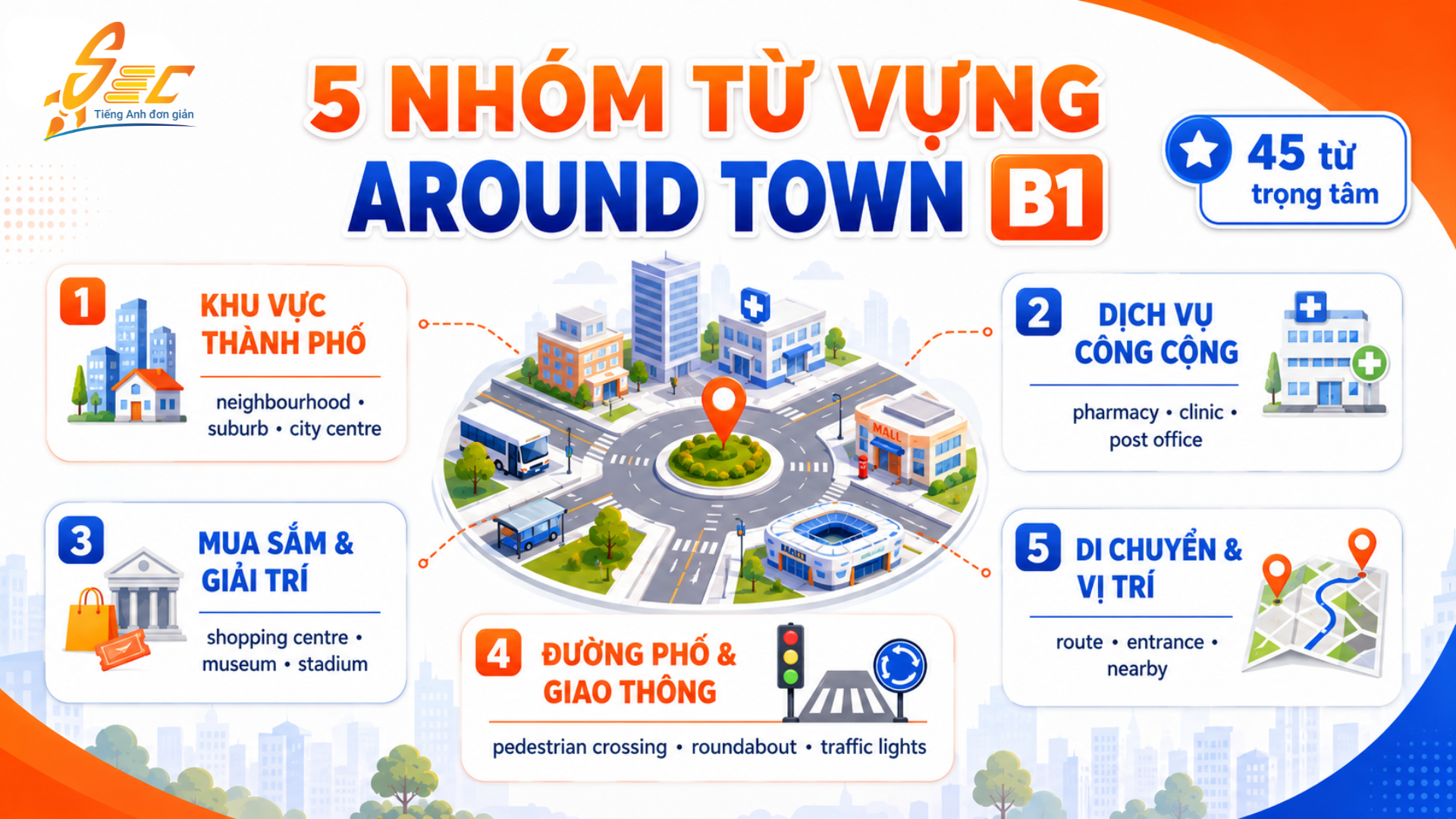
1. Khu vực và không gian trong thành phố
- neighbourhood: khu phố
- district: quận, khu vực
- suburb: vùng ngoại ô
- city centre: trung tâm thành phố
- residential area: khu dân cư
- public square: quảng trường công cộng
- block: dãy nhà, khu nhà
- landmark: địa danh hoặc công trình nổi bật
Ví dụ: My office is in the business district, but I live in a quiet suburb.
2. Địa điểm cung cấp dịch vụ
- pharmacy: hiệu thuốc
- clinic: phòng khám
- police station: đồn cảnh sát
- fire station: trạm cứu hỏa
- post office: bưu điện
- town hall: tòa thị chính
- library: thư viện
- convenience store: cửa hàng tiện lợi
Ví dụ: The pharmacy is between the post office and the local clinic.
3. Địa điểm mua sắm, văn hóa và giải trí
- shopping centre: trung tâm mua sắm
- department store: cửa hàng bách hóa
- museum: bảo tàng
- art gallery: phòng trưng bày nghệ thuật
- theatre: nhà hát
- stadium: sân vận động
- sports centre: trung tâm thể thao
Ví dụ: We visited the museum before going shopping at the department store.
4. Đường phố và cơ sở hạ tầng giao thông
- pedestrian crossing: vạch sang đường
- pavement: vỉa hè
- crossroads: ngã tư
- junction: giao lộ
- roundabout: vòng xuyến
- traffic lights: đèn giao thông
- one-way street: đường một chiều
- cycle lane: làn đường cho xe đạp
- signpost: biển chỉ đường
Ví dụ: Turn left at the crossroads and continue to the next roundabout.
5. Di chuyển và mô tả vị trí
- route: tuyến đường
- direction: phương hướng, chỉ dẫn
- distance: khoảng cách
- entrance: lối vào
- exit: lối ra
- corner: góc đường
- nearby: gần đó
- within walking distance: trong khoảng cách có thể đi bộ
- two blocks away: cách hai dãy nhà
- opposite: đối diện
Ví dụ: The main entrance is opposite the bus stop and two blocks away from the station.
Word family cần nhớ trong chủ đề Around Town
| Từ gốc | Danh từ | Động từ | Tính từ | Trạng từ | Ví dụ ứng dụng |
| direct | direction | direct | direct, directional | directly | Go directly to the main entrance. |
| locate | location | locate | located, local | locally | The library is conveniently located near the station. |
| reside | residence, resident | reside | residential | — | They live in a residential area. |
| access | access | access | accessible | accessibly | The building is accessible by public transport. |
| convenience | convenience | — | convenient | conveniently | The hotel is conveniently located in the city centre. |
| crowd | crowd | crowd | crowded | — | The market becomes crowded in the evening. |
| connect | connection | connect | connected | — | The bus route connects the suburb with the city centre. |
| enter | entrance, entry | enter | — | — | Please enter through the main entrance. |
| transport | transport, transportation | transport | transport-related | — | Public transport is available throughout the district. |
| commute | commute, commuter | commute | commuting | — | Many commuters travel into the city every morning. |
Một số dạng từ dễ nhầm cần chú ý:
- location là danh từ: The location is convenient.
- located là tính từ phân từ: The hotel is located near the station.
- convenience là danh từ: The location offers convenience.
- convenient là tính từ: It is a convenient location.
- conveniently là trạng từ: The shop is conveniently located.
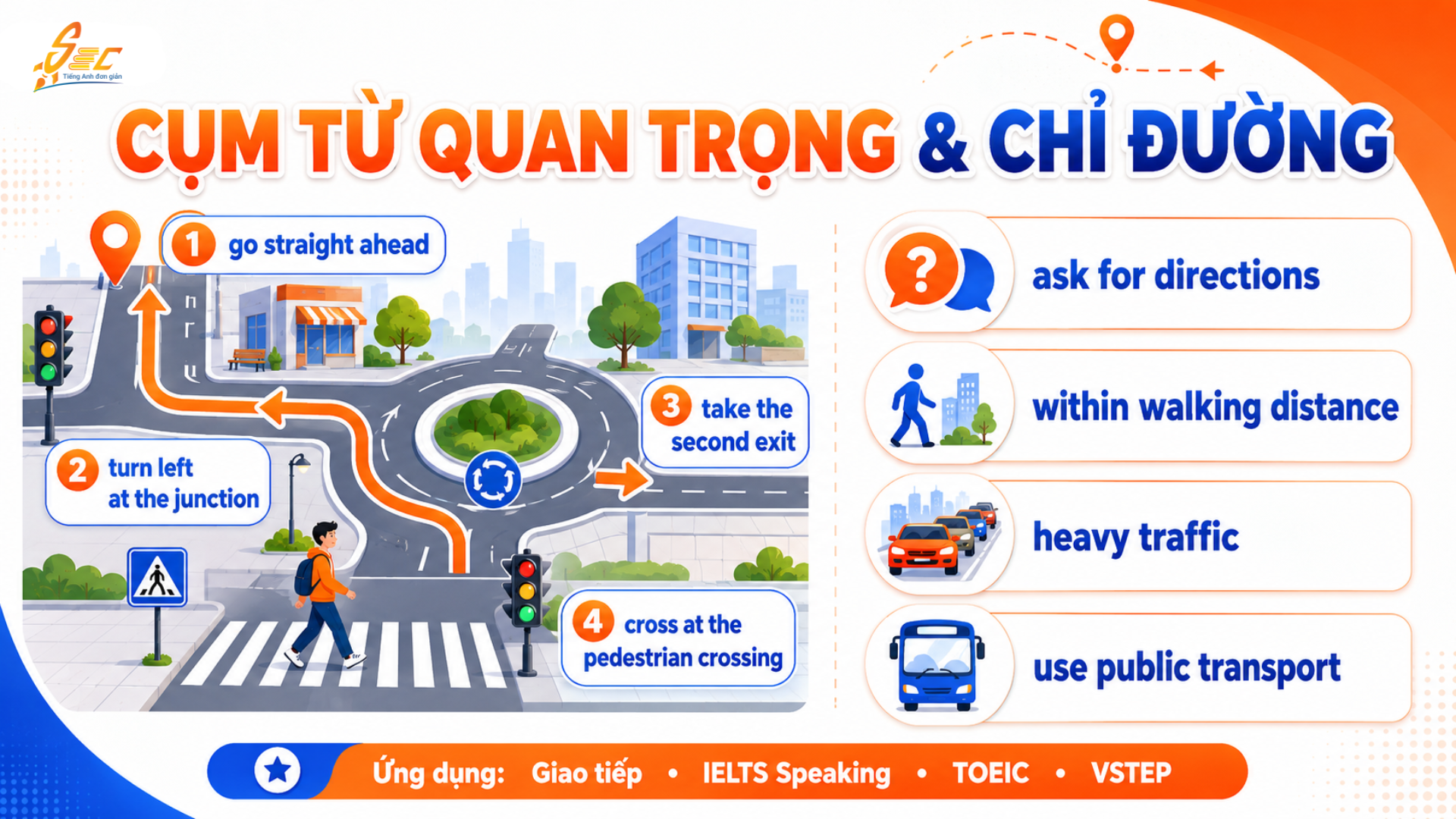
Collocations và cụm từ tự nhiên chủ đề Around Town
| Collocation/Phrase | Nghĩa tiếng Việt | Dùng trong ngữ cảnh nào? | Ví dụ |
| in the city centre | ở trung tâm thành phố | Nói vị trí của địa điểm | The hotel is in the city centre. |
| live in a residential area | sống trong khu dân cư | Mô tả nơi ở | I live in a quiet residential area. |
| a famous local landmark | địa danh nổi tiếng tại địa phương | Mô tả công trình nổi bật | The old bridge is a famous local landmark. |
| within walking distance | trong khoảng cách có thể đi bộ | Nói khoảng cách gần | The station is within walking distance. |
| a short walk from | cách một quãng đi bộ ngắn | Mô tả vị trí thuận tiện | The café is a short walk from the museum. |
| get around town | di chuyển quanh thành phố | Nói về việc đi lại | Buses are a cheap way to get around town. |
| ask for directions | hỏi đường | Khi không biết đường | I asked a police officer for directions. |
| give clear directions | chỉ đường rõ ràng | Hướng dẫn người khác | She gave me clear directions to the station. |
| follow the directions | làm theo chỉ dẫn | Đi theo hướng đã được chỉ | Follow the directions on the signpost. |
| go straight ahead | đi thẳng về phía trước | Chỉ đường | Go straight ahead for about 200 metres. |
| turn left at the junction | rẽ trái tại giao lộ | Chỉ đường | Turn left at the next junction. |
| take the second exit | đi theo lối ra thứ hai | Chỉ đường tại vòng xuyến | Take the second exit at the roundabout. |
| cross at the pedestrian crossing | sang đường tại vạch sang đường | Hướng dẫn an toàn | Cross at the pedestrian crossing. |
| stop at the traffic lights | dừng tại đèn giao thông | Mô tả giao thông | Stop at the traffic lights and turn right. |
| on the corner of | ở góc giao với | Mô tả địa chỉ | The bank is on the corner of Green Street. |
| heavy traffic | giao thông đông đúc | Mô tả lượng phương tiện | There is heavy traffic during rush hour. |
| avoid rush hour | tránh giờ cao điểm | Nói về kế hoạch di chuyển | We left early to avoid rush hour. |
| find a parking space | tìm chỗ đỗ xe | Đi lại bằng ô tô | It was difficult to find a parking space. |
| use public transport | sử dụng phương tiện công cộng | Nói thói quen đi lại | I usually use public transport to get to work. |
| catch a bus | bắt xe buýt | Nói về phương tiện | We need to catch a bus to the city centre. |
Lỗi sai thường gặp khi dùng từ vựng Around Town
1. Dùng “go to city centre” thiếu mạo từ
- Câu sai: I am going to city centre.
- Câu đúng: I am going to the city centre.
- Giải thích: Cụm city centre thường đi với mạo từ the khi nói về trung tâm của một thành phố cụ thể.
2. Dùng “arrive to” với địa điểm
- Câu sai: We arrived to the station at 8 a.m.
- Câu đúng: We arrived at the station at 8 a.m.
- Giải thích: Dùng arrive at với địa điểm nhỏ như station, airport hoặc building; dùng arrive in với thành phố và quốc gia.
3. Thêm giới từ sau “near”
- Câu sai: The bank is near from my house.
- Câu đúng: The bank is near my house.
- Giải thích: Near đi trực tiếp với danh từ, không dùng thêm from.
4. Dùng “turn to the left” trong chỉ đường thông thường
- Câu sai: Turn to the left at the traffic lights.
- Câu đúng: Turn left at the traffic lights.
- Giải thích: Khi chỉ đường, cấu trúc tự nhiên là turn left hoặc turn right.
5. Dùng “straightly” thay cho “straight”
- Câu sai: Go straightly for two blocks.
- Câu đúng: Go straight for two blocks.
- Giải thích: Trong cụm chỉ đường, straight được dùng như trạng từ.
6. Nói “the traffic is crowded”
- Câu sai: The traffic is very crowded this morning.
- Câu đúng: The traffic is very heavy this morning.
- Giải thích: Dùng heavy traffic để nói có nhiều phương tiện. Crowded thường mô tả đường phố, xe buýt hoặc địa điểm có nhiều người.
7. Nhầm “in front of” với “opposite”
- Câu sai: The bank is in front of the supermarket, on the other side of the road.
- Câu đúng: The bank is opposite the supermarket.
- Giải thích: Opposite chỉ hai địa điểm nằm đối diện nhau. In front of chỉ một vật hoặc người nằm ngay phía trước một địa điểm khác.
8. Dùng sai số ít của “traffic lights”
- Câu sai: Turn right at the traffic light.
- Câu đúng: Turn right at the traffic lights.
- Giải thích: Khi nói về cụm đèn tại một giao lộ, tiếng Anh Anh thường dùng traffic lights ở dạng số nhiều.
Tham khảo thêm: Những lỗi dùng từ phổ biến khi giao tiếp tiếng Anh
Phân biệt các từ dễ nhầm trong chủ đề Around Town
| Từ dễ nhầm | Khác nhau thế nào? | Ví dụ đúng |
| town – city | Town thường nhỏ hơn và có ít dân hơn city. City thường có hệ thống dịch vụ, giao thông và khu vực đô thị lớn hơn. | I grew up in a small town but now work in a large city. |
| street – road – avenue | Street thường có nhà và cửa hàng hai bên. Road là tuyến đường nối các địa điểm. Avenue thường là đường lớn, rộng trong thành phố. | The café is on King Street, near the main road. |
| crossing – crossroads | Crossing là nơi người đi bộ sang đường. Crossroads là nơi hai con đường giao nhau. | Use the crossing, then turn left at the crossroads. |
| crossroads – junction – roundabout | Crossroads thường là giao điểm của hai đường. Junction là điểm các đường nối nhau. Roundabout là vòng xuyến. | Take the first exit at the roundabout. |
| near – nearby – next to | Near là gần. Nearby có thể đứng trước danh từ hoặc đứng một mình. Next to là ngay bên cạnh. | There is a nearby café next to the library. |
| opposite – in front of | Opposite là ở phía bên kia hoặc đối diện. In front of là ở ngay phía trước. | The station is opposite the park, and a taxi is waiting in front of it. |
| suburb – outskirts – neighbourhood | Suburb là khu dân cư ngoài trung tâm. Outskirts là khu vực rìa ngoài của thành phố. Neighbourhood là khu phố nơi mọi người sinh sống. | She lives in a quiet neighbourhood in the suburbs. |
| route – direction | Route là tuyến đường cụ thể từ nơi này đến nơi khác. Direction là phương hướng hoặc lời chỉ dẫn. | This route is shorter, but I still need directions. |
Đoạn mẫu sử dụng từ vựng Around Town level B1
Last Saturday, I met my cousin in the city centre. We planned to visit a new art gallery, but neither of us knew the exact route. We stopped at a bus stop and asked a local woman for directions. She told us to go straight ahead, turn left at the traffic lights and walk past a large department store. The gallery was on the corner of Green Street, opposite a famous local landmark. It was only a short walk from the bus stop, so the location was very convenient. After the exhibition, we walked through a crowded public square and found a small café in a quiet neighbourhood nearby.
Giải thích từ và cụm từ nổi bật:
- city centre: trung tâm thành phố
- art gallery: phòng trưng bày nghệ thuật
- route: tuyến đường
- bus stop: điểm dừng xe buýt
- directions: lời chỉ đường
- go straight ahead: đi thẳng về phía trước
- traffic lights: đèn giao thông
- department store: cửa hàng bách hóa
- on the corner of: ở góc đường
- local landmark: địa danh nổi bật tại địa phương
- a short walk from: cách một quãng đi bộ ngắn
- convenient: thuận tiện
- public square: quảng trường công cộng
- neighbourhood: khu phố
Bài tập từ vựng Around Town level B1
Task 1: Match words with meanings
Nối từ ở cột A với nghĩa phù hợp ở cột B.
| Cột A | Cột B |
| 1. suburb | A. vạch sang đường cho người đi bộ |
| 2. landmark | B. khu vực nằm ngoài trung tâm thành phố |
| 3. pavement | C. biển cung cấp thông tin về hướng đi |
| 4. crossroads | D. địa danh hoặc công trình dễ nhận biết |
| 5. signpost | E. nơi hai con đường giao nhau |
| 6. entrance | F. vỉa hè |
| 7. pedestrian crossing | G. lối vào |
| 8. pharmacy | H. tuyến đường từ nơi này đến nơi khác |
| 9. route | I. hiệu thuốc |
| 10. residential area | J. khu dân cư |
Task 2: Fill in the blanks
Điền từ thích hợp vào chỗ trống.
Word bank: nearby – roundabout – convenient – directions – crowded – exit – district – distance – traffic lights – pavement
- The office is located in the business __________.
- Turn right after the __________.
- We asked a police officer for __________.
- The station is within walking __________ of the hotel.
- Do not walk in the road. Stay on the __________.
- Take the third __________ at the roundabout.
- The market becomes very __________ at weekends.
- This apartment is in a very __________ location.
- Is there a convenience store __________?
- Go around the __________ and take the first exit.
Task 3: Choose the correct answer
- The bank is ________ the post office, on the other side of the street.
A. opposite
B. inside
C. along
D. through - We arrived ________ the train station at 6:30.
A. to
B. at
C. on
D. from - Go straight and turn left ________ the next junction.
A. in
B. from
C. at
D. between - There was ________ traffic in the city centre this morning.
A. strong
B. heavy
C. crowded
D. full - The hotel is ________ walking distance of the museum.
A. within
B. between
C. along
D. across - The café is ________ the corner of Park Street and Hill Road.
A. at
B. to
C. on
D. into - Which word refers to an area outside the centre of a city?
A. landmark
B. suburb
C. crossing
D. pavement - You should cross the road at the ________.
A. residential area
B. car park
C. pedestrian crossing
D. department store - We took a different ________ to avoid rush-hour traffic.
A. route
B. direction
C. distance
D. entrance - The museum is conveniently ________ near an underground station.
A. location
B. locating
C. located
D. locate
Task 4: Vocabulary in context
Đọc đoạn văn và trả lời câu hỏi.
Mai recently moved from a small town to a busy suburb of Hanoi. Her new neighbourhood is more crowded, but it is also more convenient. There is a supermarket, a pharmacy and a public library within walking distance of her apartment. A bus stop is located opposite the main entrance to her building, so she can easily get to the city centre.
On her first day at work, Mai took the wrong route and got off the bus two stops early. She asked a shop assistant for directions. The assistant told her to walk along the pavement, cross the road at the pedestrian crossing and turn right at the next junction. Mai followed the instructions and reached her office on time. She now uses a map application, especially when she needs to travel through an unfamiliar district.
- Why does Mai think her new neighbourhood is convenient?
- Where is the bus stop?
- What mistake did Mai make on her first day at work?
- Which three instructions did the shop assistant give her?
- What does the word unfamiliar mean in the final sentence?
Task 5: Application practice
Trả lời mỗi câu hỏi bằng 3–5 câu. Cố gắng sử dụng ít nhất hai từ hoặc collocations trong bài.
- What places are within walking distance of your home?
- How do you usually get around your town or city?
- Describe the route from your home to the nearest supermarket.
- Is your neighbourhood quiet or crowded? Why?
- What changes would make your local area more convenient?
Đáp án bài tập từ vựng Around Town level B1
Task 1:
1–B
2–D
3–F
4–E
5–C
6–G
7–A
8–I
9–H
10–J
Task 2:
- district – Cụm business district chỉ khu vực tập trung nhiều văn phòng và hoạt động kinh doanh.
- traffic lights – Cấu trúc chỉ đường: turn right after the traffic lights.
- directions – Cụm đúng là ask someone for directions.
- distance – Cụm cố định: within walking distance.
- pavement – Người đi bộ di chuyển trên vỉa hè.
- exit – Dùng take the first/second/third exit tại vòng xuyến.
- crowded – Tính từ mô tả địa điểm có nhiều người.
- convenient – Tính từ đứng trước danh từ location.
- nearby – Nearby có thể đứng cuối câu với nghĩa “ở gần đây”.
- roundabout – Cấu trúc: go around the roundabout.
Task 3:
- A. opposite – Hai địa điểm nằm ở hai phía đối diện của đường.
- B. at – Dùng arrive at với nhà ga và các địa điểm cụ thể.
- C. at – Cụm chỉ đường đúng là turn at the junction.
- B. heavy – Collocation đúng là heavy traffic.
- A. within – Cụm cố định within walking distance.
- C. on – Dùng on the corner of + tên hai đường.
- B. suburb – Suburb là vùng dân cư nằm ngoài trung tâm thành phố.
- C. pedestrian crossing – Đây là khu vực dành cho người đi bộ sang đường.
- A. route – Route là tuyến đường cụ thể được lựa chọn để di chuyển.
- C. located – Cấu trúc bị động be located + giới từ chỉ nơi chốn.
Task 4:
- Mai thấy khu phố mới thuận tiện vì siêu thị, hiệu thuốc và thư viện đều nằm trong khoảng cách có thể đi bộ.
- Điểm dừng xe buýt nằm đối diện lối vào chính của tòa nhà.
- Mai đi sai tuyến đường và xuống xe sớm hai điểm dừng.
- Người bán hàng bảo Mai đi dọc vỉa hè, sang đường tại vạch dành cho người đi bộ và rẽ phải ở giao lộ tiếp theo.
- Unfamiliar có nghĩa là không quen thuộc hoặc chưa biết rõ.
Task 5: Bài trả lời tham khảo
- There is a convenience store and a pharmacy within walking distance of my home. The nearest bus stop is two blocks away.
- I usually get around town by bus. I avoid rush hour because the traffic is often heavy.
- Go straight ahead from my house and turn left at the traffic lights. The supermarket is opposite the public library.
- My neighbourhood is quite crowded during the day because it is near a shopping centre. However, it becomes quieter in the evening.
- More cycle lanes and pedestrian crossings would make my local area safer. A new bus route would also make it more convenient.
Ứng dụng từ vựng Around Town level B1 vào giao tiếp và bài thi
| Mục tiêu học | Cách ứng dụng | Ví dụ |
| Giao tiếp hằng ngày | Hỏi đường, chỉ đường, tìm địa điểm và mô tả khu vực đang sống | Excuse me, could you give me directions to the nearest pharmacy? |
| IELTS Speaking/Writing | Mô tả quê hương, khu phố, giao thông hoặc những thay đổi cần thực hiện trong thành phố | My neighbourhood is conveniently located near the city centre, but it suffers from heavy traffic. |
| TOEIC Reading/Listening | Hiểu thông báo về địa điểm, lịch trình, bản đồ, lối vào, lối ra và phương tiện công cộng | The conference entrance is opposite the underground station. |
| VSTEP Speaking/Writing | Trình bày ưu điểm, hạn chế của khu vực sống và đề xuất cải thiện cơ sở hạ tầng | The local authority should build more pedestrian crossings and improve public transport. |
Trong giao tiếp, người học cần luyện các câu hỏi hoàn chỉnh thay vì chỉ nói tên địa điểm:
- Could you tell me the way to the station?
- Is there a pharmacy nearby?
- How long does it take to get to the city centre?
- Is it within walking distance?
- Which bus should I take?
Trong bài nói hoặc bài viết, các collocations giúp câu trả lời tự nhiên và cụ thể hơn:
- live in a residential area
- use public transport
- suffer from heavy traffic
- avoid rush hour
- be conveniently located
- improve local facilities
Tham khảo thêm: Từ và cụm từ chỉ hướng trong tiếng Anh
Tải tài liệu bài tập từ vựng Around Town level B1
TẢI BỘ BÀI TẬP TỪ VỰNG AROUND TOWN LEVEL B1 KÈM ĐÁP ÁN: [LINK TẢI TÀI LIỆU]
FAQ về từ vựng Around Town level B1
1. Chủ đề Around Town ở level B1 cần học bao nhiêu từ?
Người học nên nắm khoảng 40–55 từ và cụm từ trọng tâm, tập trung vào địa điểm, đường phố, giao thông, vị trí và cách chỉ đường.
2. Có cần học collocations khi học chủ đề Around Town không?
Có. Collocations như heavy traffic, ask for directions, within walking distance và take the second exit giúp người học nói và viết tự nhiên hơn.
3. Từ vựng Around Town có dùng được trong bài thi không?
Có. Chủ đề này có thể xuất hiện trong bài nghe về bản đồ và chỉ đường, bài đọc về thành phố hoặc bài nói về khu vực sinh sống, quê hương và giao thông.
4. Làm sao để nhớ từ vựng về địa điểm lâu hơn?
Hãy vẽ một bản đồ khu phố, ghi tên các địa điểm bằng tiếng Anh và tự luyện chỉ đường từ nhà đến từng địa điểm. Cách này kết hợp hình ảnh, ngữ cảnh và thực hành nói.
5. Có nên học idioms trong chủ đề Around Town ở trình độ B1 không?
Idioms chưa phải trọng tâm. Người học nên ưu tiên từ vựng chính xác, collocations thông dụng và các mẫu câu hỏi – chỉ đường có tính ứng dụng cao.
6. “Opposite” có cần đi với giới từ “to” không?
Trong cách dùng phổ biến, có thể nói opposite the bank. Cấu trúc này ngắn gọn và tự nhiên khi mô tả vị trí.
Kết luận
Từ vựng Around Town B1 giúp người học xử lý nhiều tình huống thực tế như hỏi đường, sử dụng phương tiện công cộng, tìm địa điểm và mô tả khu vực sinh sống. Để sử dụng từ chính xác, cần học theo nhóm nghĩa, word family, collocations và câu ví dụ thay vì ghi nhớ từng từ riêng lẻ.
Sau khi hoàn thành bài tập, hãy tự mô tả đường từ nhà đến một địa điểm quen thuộc và làm lại các câu còn sai. Việc đưa từ mới vào tình huống thật sẽ giúp kiến thức được ghi nhớ lâu hơn và chuyển thành khả năng giao tiếp.
Xem thêm
- 350 từ vựng tiếng Anh lớp 7 theo từng Unit
- Từ vựng địa điểm và hướng đi trong tiếng Anh
- 500 từ vựng tiếng Anh cơ bản theo chủ đề
- Từ vựng tiếng Anh về du lịch và khám phá địa điểm